


- 5traditions
- 3pieces of kit
- 7 minread
Where the scene picks it up
London Ice Cream: The Technique, the Flavours, and Where It Sells
Two decades of borrowing from everywhere, and a counter that now looks nothing like the one your parents queued at. The equipment changed first, the flavours followed.
What makes the London scene its own thing
Not a style of its own. A city that took four of them and put them on one street.
- 01
The pozzetto
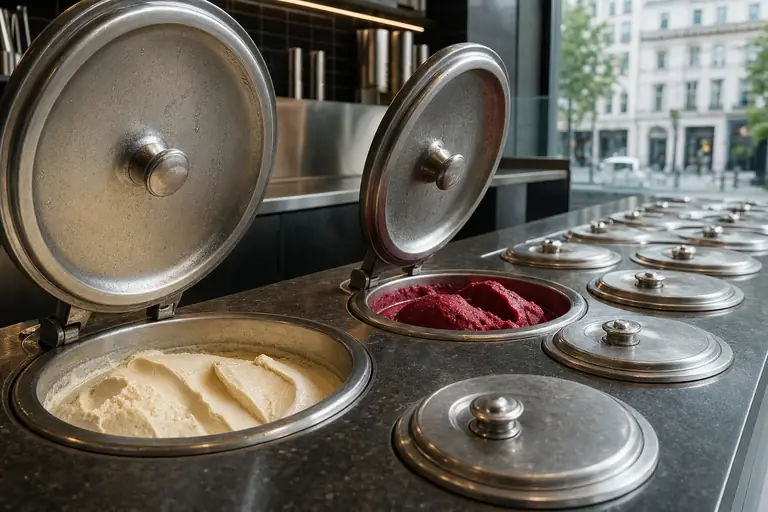
A covered well holds a warmer, softer scoop without the surface drying out.
- 02
The batch freezer
Small enough to sit behind a shopfront, which is what made a short daily board possible.
- 03
Scale pasteurising
What makes an egg-yolk crema practical for a single site rather than a factory.

London has no native tradition. It has five borrowed ones.
What to read on a counter:covered pozzetti rather than a piled display. A board under about twelve. A flat spade. Dull sage pistachio. Any three of those four and the base was made on site this morning.
London has no native frozen-dessert tradition worth the name. What it has instead is the thing that makes its food scene work generally: enough migration, enough money and enough competition that four or five separate traditions ended up on the same high street, each made properly rather than approximated.
So the London ice cream scene is not one thing. It is Italian gelato, Argentine helado, Japanese soft serve, Middle Eastern stretchy dondurma-style ice cream and the surviving British kiosk trade, all within a bus ride, and mostly not pretending to be each other. That is unusual, and it is the honest reason a visitor finds the counters more interesting here than the recipes.
The equipment that changed the counters
Three pieces of kit did more to change London ice cream than any recipe. The first is the pozzetto: a covered stainless well sunk into the counter, holding the product at a stable temperature away from light and air. It replaced the lit display cabinet in most serious shops, and the reason is not aesthetics. A covered well holds a warmer, softer product without the surface drying, so the scoop that reaches the cone is the scoop that was made.
The second is the batch freezer, small enough to sit behind a shopfront rather than in a factory. Once a single site could churn twenty litres in the morning, a short daily board became possible, and the short board became the signal that the base was fresh. The third is pasteurising equipment at that same scale, which is what makes an egg-yolk crema legal and practical for a small operator rather than an industrial one.
Liquid nitrogen counters had a moment and mostly did not last. Freezing fast does give very small ice crystals and a genuinely smooth result, but it is a theatre-led format with a high running cost, and the same smoothness is reachable with a good base and a slow churn. What survived from that wave is the made-to-order habit rather than the nitrogen.
What actually sells here
The British palate is not the Italian one, and London boards reflect that in a way that surprises people who expect a straight copy. Salted caramel outsells everything that is not chocolate or vanilla. Pistachio is the prestige order and the flavour a new shop is judged on. Rhubarb and custard, clotted cream and strawberries-and-cream are the specifically British entries, and they are on boards in Soho that would be unthinkable in Bologna.
Sorbets do better here than in Italy, partly because the dairy-free market is larger and partly because a London summer rewards something sharp. And the flake is still on the menu at the kiosk end of the trade, which is covered on the British industry page.

Where the trade clusters
Not a directory and not a ranking. These are the areas where the counters concentrate, and each cluster has a reason that has nothing to do with ice cream.
- Soho and Covent GardenFootfall, and the oldest Italian presence in the city. The highest density of counters and the highest rents to go with it.
- CamdenMarket trade and a young crowd, which is where the made-to-order and novelty formats concentrate.
- Shoreditch and HackneyWhere the small-batch producers actually are, because the arches and light-industrial space are. Production first, counters second.
- Notting HillLong-established parlours serving a residential trade rather than tourists, and boards that change with the season because the same people return.
- Borough and BermondseyMarket and railway arches again. Wholesale and stall trade more than shopfronts.
- BrixtonCaribbean and Latin American influence, which is the part of the London scene closest to the Argentine and Colombian traditions.
- GreenwichWeekend and river trade, and the closest thing inner London has to the seaside kiosk pattern.
What a London board carries
Ten flavours that between them cover most counters in the city, and what each one is there to do.
| Flavour | What it is doing | Group |
|---|---|---|
| Vanilla | The control sample. Order it first at a shop you do not know. | Core |
| Dark chocolate | Usually a sorbet in the better shops, which makes it darker and sharper. | Core |
| Salted caramel | Outsells everything that is not chocolate or vanilla, by a distance. | Core |
| Pistachio | The flavour a new shop is judged on, and the one that exposes a cheap base. | Prestige |
| Strawberries and cream | A dairy base rather than a sorbet, which is the British reading of it. | British |
| Rhubarb and custard | Sharp fruit against a yolk base. No Italian board would carry it. | British |
| Clotted cream | A regional signal and a very high fat one. Rich enough to be a single scoop. | British |
| Mint choc chip | The flavour that reads identically in every country. Safe, and it sells. | Core |
| Lemon sorbet | The palate reset, and the dairy-free default on most London boards. | Sorbet |
| Coffee | A city that takes its coffee seriously takes this seriously too. | Core |
Questions about London ice cream
What people ask before deciding a counter is worth the queue.
What is a pozzetto and why does it matter?
A covered stainless well sunk into the counter, holding the product at a stable temperature away from light and air. It matters because a covered well keeps a warmer, softer scoop without the surface drying out, so what reaches the cone is what was made that morning.
Is a piled, brightly coloured display a bad sign?
Usually. Product piled high in an open lit cabinet has to be held colder and stiffer to hold that shape, and the colour that makes it photograph well rarely comes from the ingredient. Covered wells and a duller board are the better signal.
What is the most popular ice cream flavour in London?
Vanilla and chocolate still lead by volume, as they do almost everywhere. The interesting number is third place, which in London is salted caramel by a clear margin, ahead of both strawberry and mint.
Did liquid nitrogen ice cream disappear?
Mostly, as a format. Freezing fast genuinely does give smaller ice crystals, but the running cost is high and the same smoothness is reachable with a good base and a slow churn. What survived is the made-to-order habit rather than the nitrogen itself.
Where should someone start in London?
With a plain scoop rather than a place. Order vanilla or a crema at whichever counter is in front of you: if the plain one is good the board behind it is worth exploring, and if it is not, nothing further along will rescue it. This site names no shops.